Book Review | It Can’t Happen Here by Sinclair Lewis

So, I think everyone can agree, right now, that things are a mess, and have been for a while. Of course, being a fan of both dystopias and alternate histories, I decided to pick this book up from my bookshelves, after avoiding it for the last year or so. It Can’t Happen Here was Sinclair Lewis’s imaginings of what could happen if fascism took hold in 1930s America, following the events as they play out in the life of newspaper editor Doremus Jessup and his family. And while at times it feels a little hokey, it’s also chilling.

The book does a pretty good job of exploring the idea of a fascist 1930s America. The thing is, I love dystopias but they’re often far enough removed from one’s own reality as to lose a little bit of horror. With this book, the setting and the character of the place is familiar enough (even with the strange 1930s-style language and references and such) that its all a little more real. The bare glimpses of what happened in our own world during WWII makes the events all the more disturbing at times.

I mean, I must admit, at times the situations feel a little far-fetched. There’s certainly a rush-job as far as setting up this totalitarian state, but for all those moments there’s another line that sounds sounds straight out of an article printed today, capturing a time ‘when [instead of standard politics] the electorate hungered for frisky emotions… baptism by emersion in the creek, young love under the elms… fear of death when an automobile teeters above a canyon… -all the primitive sensations which they thought they found in the screaming of Buzz Windrip.” The words of the novel echo the news headlines and internet gossip of today, and doesn’t that just make one feel all warm and cozy and not ready to scream into the night.

A problem arises with the dialogue, however, in that it’s weird and stilted at times. It feels vaguely like watching a melodramatic film from the same time period, to the extent that my brain was framing many of the scenes in black and white 30s movie sets. It was a notable problem, in that, while reading, I’d suddenly noticed the quality of the writing dipping… and then I realized it was because I’d hit into a section of dialogue. This is one of the only books I’ve read in which I found myself preferring the narration over the portions with verbal character interaction.
Let’s Talk Bookish: Are Big TBRs a Result of Abibliophobia?

Wow. Me writing something other than reviews and Thankful Thursday posts? Yeah, I know. Weird. But I think it’s time to venture out of my comfort zone, and it’s fun to connect with people about books, even if I’m no good at it overall. And the sorts of discussions with the Let’s Talk Bookish meme, hosted by Rukky @ Eternity Books and Dani @ Literary Lion, look right up my alley.

This week’s topic of is abibliophobia, which I’d admittedly never heard of until this past week, and big TBRs, which…. I think “big” may be an understatement in my case.

Sometimes my whole office feels like a giant TBR pile.

Do I, possibly, have abibliophobia? No, not really. Phobias are something I think of as pretty intense, and I’ve never had that sort of reaction to the possibility of not having a book or magazine or newspaper, etc. Not even in a milder form.

I think my overlarge TBR is a result of semi-pragmatic impulsive overstocking.

Sorry, that was a mouthful.

I don’t fear having nothing to read, especially since the advent of the internet, but being a bookworm who only got a new book every now and then as a kid and didn’t get access to the public library until middle school probably had some effect. I remember a lot of days staring at my bookshelf, trying to figure out what to reread.

Though the connected emotion is really more akin to annoyance than anything else, because part of my problem is pickiness. I can’t pretend I didn’t have access to books. It wasn’t strange in my family to see a carefully chosen selection floating down the checkout counter at Walmart, though their selection was thin, and I was lucky enough to have a bookworm cousin who gave me plenty of hand-me-downs, though aside from the babysitter club books, a fairly large portion of those were very much of the ABC Afterschool Special variety, and I was more interested in mysteries and ghosts and dark-fantasy and the occasional controversial-subject-chosen-specifically-to-scandalize-my-Christian-school-teachers.

That hasn’t changed much over the years, though my tastes have broadened a little at least.

Still, while my local libraries are nice to have, the ones in rural Appalachia aren’t known for extensive collections, and interlibrary loans only get you so far sometimes. If I find a book that sparks my interest while I’m in a thrift store, I’m probably going to pick it up, because I have no idea if I’ll see it again any time soon. So I get a book here and a small stack of books there, and I don’t really think about it until one day I turn around and I have a full five-shelf-bookshelf worth of books I’ve never cracked open.

So, no. Not a phobia. Just, at times, specific tastes.

Whatever the case, at least I have lots to choose from now.

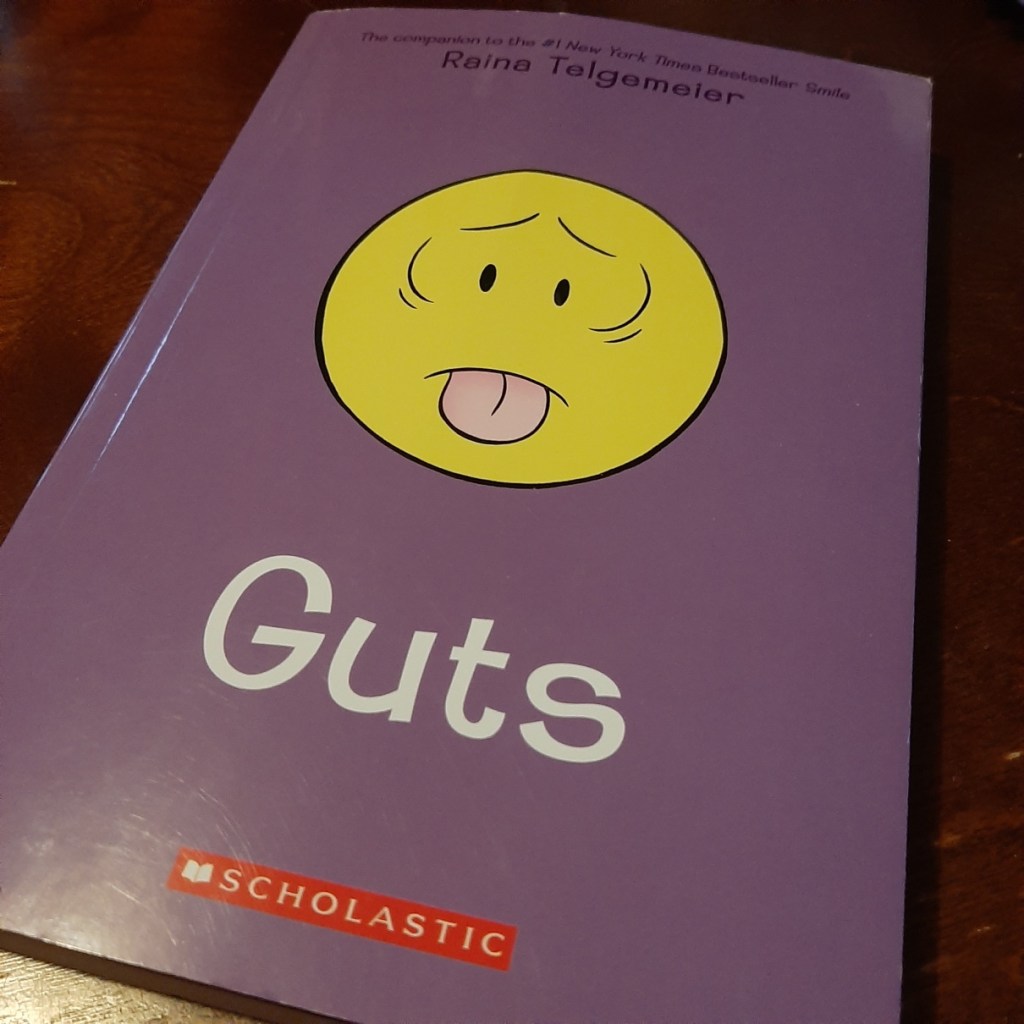
Book Review | Guts by Raina Telgemeier

Something that should be fairly evident if you look at my reading history is that I love graphic novels. I’ve loved comics ever since I was in elementary school reading first the comic strips in the newspaper, then Barbie and Sonic the Hedgehog comics. The explosion of graphic novels for middle readers, is, in my opinion, absolutely awesome and I wish there had been even half of today’s selection when I was a kid. Raina Telgemeier has been such a visible part of that explosion.

Guts is one of her autobiographical volumes, like Smile and Sisters, that deals with the events of Raina’s childhood. This time the main subject addressed is her struggle with anxiety, which took the form of panic attacks and stomach upsets (thus the title of the book).

I really like how mental health is treated in this book. As someone who dealt with anxiety as a kid (still deals with, tbh), it’s nice to see it addressed, especially in a way that’s in no way belittling. It points out the ways that our society’s tendency to hide such things has a negative impact, while still showing that, ultimately, mental health shouldn’t be any different than physical health. The protagonist eventually starts seeing a therapist, something she hides from her friends because she fears their reactions. When she does eventually reveal this fact she’s instead met with small chorus of ‘oh, that’s not so weird’.

The art, as usual in a Telgemeier book, is colorful with animated emotional expressions. The backgrounds are simple, which fits well with the overall art style while also allowing the readers full attention to focus on the characters. What is interesting in this one, however, is the way she incorporated a bunch of green in certain segments of the book- specifically, what you could call puke-green- to show first Raina’s anxiety-induced stomach issues, and then subsequently an anxiety-attack in general.

The thing that does frustrate me a little is the fact that the bad behavior of one character only slightly gets addressed. It’s not jarring, really, but I hate when a bully-character seems to have no repercussions at all. It’s never addressed by the adults, other than a teacher essentially telling the protagonist to be nice to them in hopes that they’ll be nice to the protagonist. Of course, the teacher sees what is happening behind the scenes with this character, but still… I wish there had been some acknowledgement of the problem beyond the admonishment to be kind.

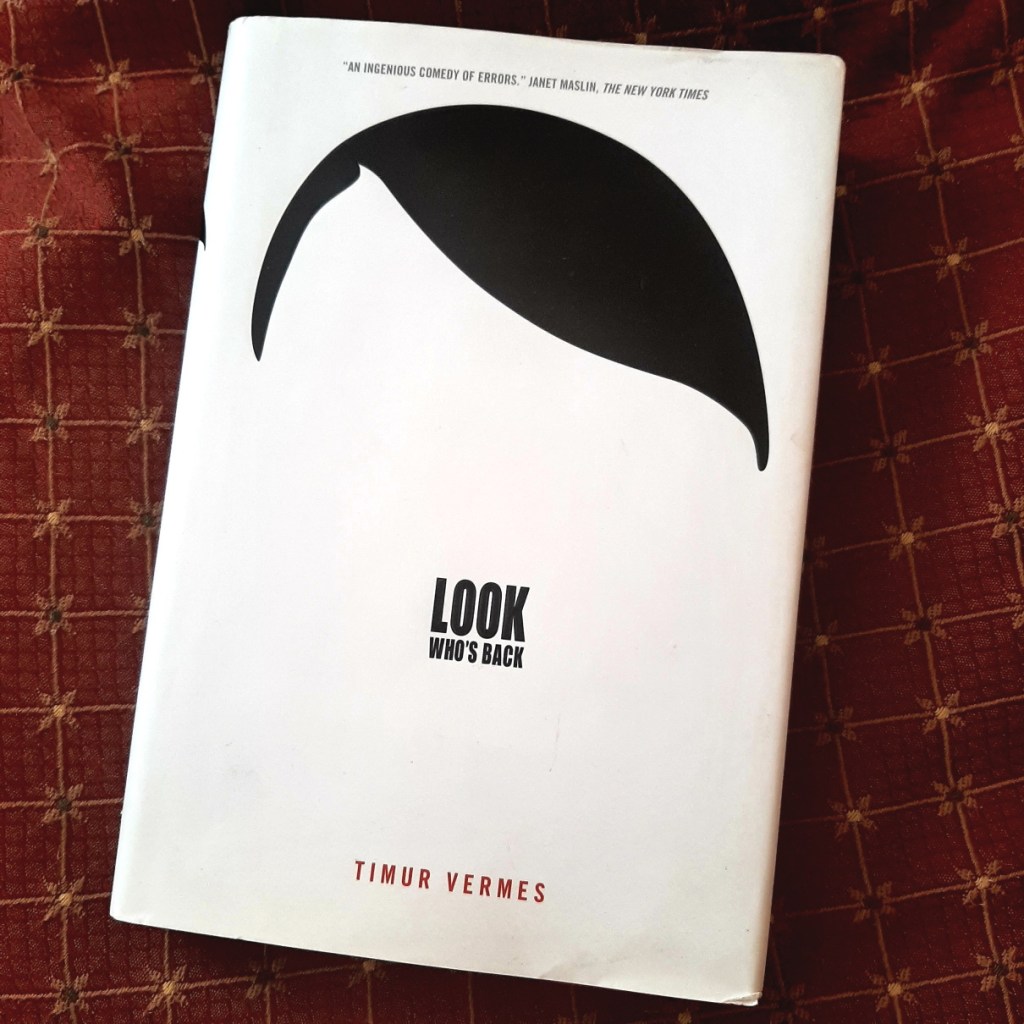
Book Review | Look Who’s Back by Timur Vermes

So, I’m going to start off by saying that this review is going to look a little different than the ones I’ve done in the past. I’ve been sitting on this book, letting my thoughts marinade, for over a week, and I’ve came to the conclusion that I can’t really approach it like a normal book.

It’s probably one of the most polarizing things I’ve read in a while.

That’s inevitable, I suppose, with a book that poses the question, ‘what-if Hitler was dropped into the beginning of the twenty-first century? That is the plot of Look Who’s Back, where Adolph Hitler is dropped unceremoniously into a random German park in the year 2011. In this alternate 2011, he is just as keen to grasp power as he was in the 1940s, and so embarks on a journey through modern media to become a YouTube and tv sensation.

Look Who’s Back, if you can’t tell already, is a commentary on our current media, particularly- from what I can tell- concerning how we as an audience approach the ‘stars’ of that media we consume. It is a strange piece of satire.

However, in my opinion, it is effective. It’s the sort of satire where, instead of laughing, you find yourself asking- pardon my french- ‘wtf?’ Part of this is, I think, due to Vermes’ treatment of his protagonist, who never completely settles into the 21st century, but rather flounders as he tries to make sense of this work- not always so effectively. And what begins as a humorous ‘look at this horrible person, now stripped of power and truly a fish out of water’, turns into something else, as few people within Hitler’s circle question him- instead assuming that he is merely portraying a character, and doing so in order to point out the flaws of our current civilization- because if Hitler says it then it much be awful.

I found myself , at times, liking this person, or at least feeling sympathy for him, even while knowing who he is, only to come back around within a few pages and be stopped dead at the hateful rhetoric which inevitably spews from Hitler’s mind. The fact that Vermes is able to do this, to capture both that sickening charisma and the monster it masks, really says something for his abilities as a writer.

That being said, there are definite slow moments in the book, sections that could have done with a bit of pruning. Some portions spend perhaps, too much time in Hitler’s head, and the affect isn’t an adding to the character, or an insightful reflection upon something, but instead of dragging of the book’s forward momentum.

In addition, there’s something to be said for the actual subject material of the book- the choice to have Hitler as the protagonist and narrator of the book at all, and thus given a voice in a brand-new era. It’s striking, the amount of times in the book where Hitler and the production company that puts him on tv, is criticized for this same thing, partially by groups who were most affected by the decisions of Hitler and Nazi Germany. These groups are subsequently dismissed as being too reactive and not seeing the satire for what it is, according to characters in the book. Hitler’s supporters refuse to consider the fact that there are still a large amount of people in Germany, as well as the world as a whole, who would gladly accept Hitler’s rhetoric as the truth- agreeing with his viewpoints wholeheartedly. The harm that those words, or just the emphasis on Hitler in general, could cause, even if used in a satirical manner.

There is, after all, a reason why naming the identify of mass-shooters, is discouraged. They don’t deserve to be remembered. The victims do.

And the same goes, in my opinion, for this book. I’m not certain we are, as a society, in a place where we can pull out these words satirically. Where we can say we’re far enough removed from the events of the past. As long as there are still people out there who would read this book as a sort of wish-fulfillment fantasy, I’m not sure we’re ready. Perhaps, a few years ago, I would have thought we were. Not so much so today.

I can’t say whether or not to read this book. It’s thought provoking and well-written, however it’s also perpetuating the hype and, arguably, celebritizing of Adolf Hitler. I’ll just leave you with that.

TBR – February 2021

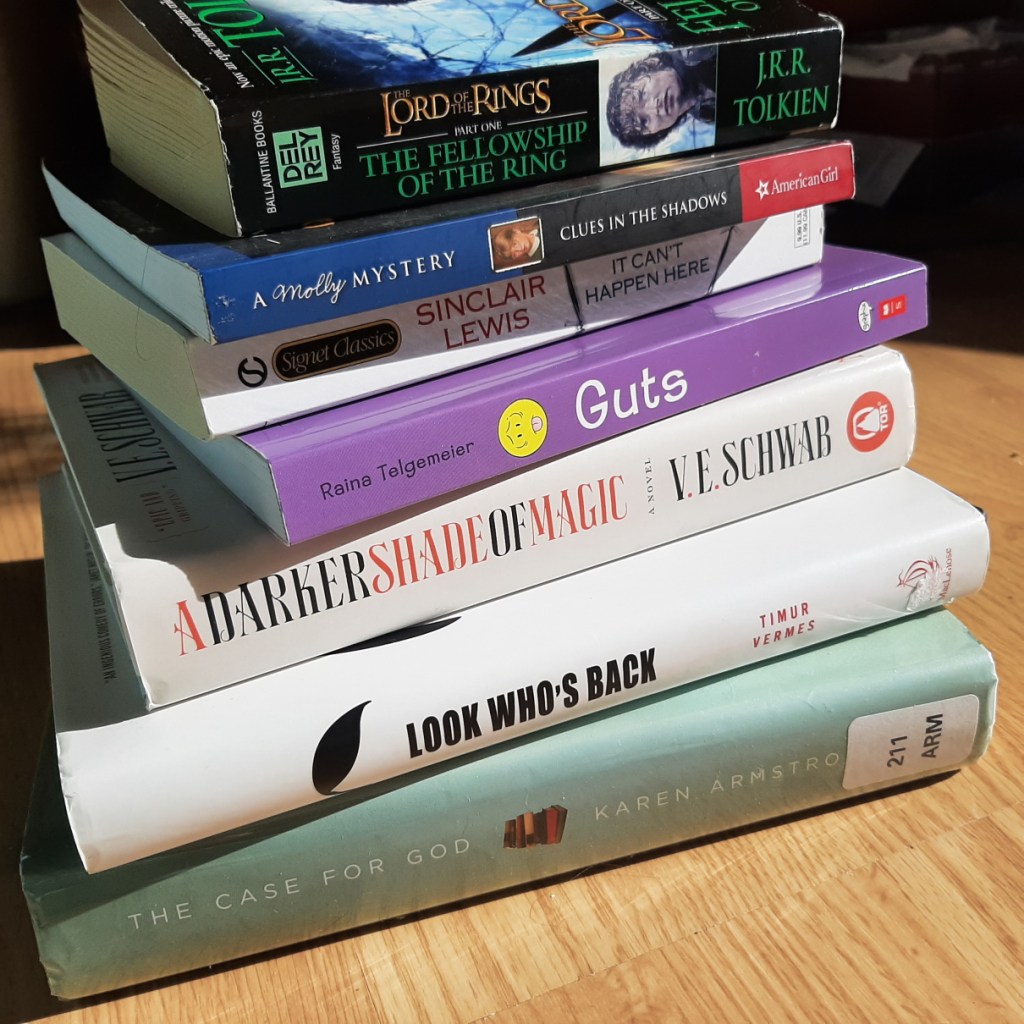
So, new month, new stack of books pulled out of my overflowing shelves. Well, half-way new. About half of them are holdovers from last month, because I didn’t get through a lot in terms of actual books.

Now do I have any intention of reading this whole stack? Good grief no. But it’s nice to narrow down my choices all in one go, rather than staring at my shelves intermittently throughout the month. Makes the choice paralysis a lot less of a thing. And if I end up just not feeling one of these it’s easier to put it aside if I have something else on hand to pick up.

Now, on to the stack.

The Fellowship of the Ring – J. R. R. Tolkien/
I’m slowly making my way through this sucker. I got a little over a hundred pages in last month, so we’ll see how far I get this time around.

Clues in the Shadows: A Molly Mystery – Kathleen Ernst
I’m admittedly a bit of an AG fangirl. I’ve read most of the original stories (minus the newer characters and the GOTY characters) but I only have a few of the mysteries, so when I see one out in the wild I tend to pick them up. I’ve had this one sitting around for a bit, but evidently I have WWII on the brain at the moment. A quick read that should work pretty good as a breather in between other books.

It Can’t Happen Here – Sinclair Lewis
I’ve tried reading this one before, but the language was kind of stilted and I just wasn’t feeling it. Figured with everything going on in the world it might be a good time to pick it up again.

Guts – Raina Telgemeier
Telgemeier is one of my favorite authors when it comes to middle grade graphic novels, so I was thrilled when I ran across another one of her books at my local thrift store.

A Darker Shade of Magic – V. E. Schwab
So, I’ve heard of this one, but I’m really walking in blind. All I know, really, is that it’s fantasy and it’s the beginning of a trilogy.

Look Who’s Back – Timur Vernes
Finishing this one up from last month. Well, technically I’ve already finished it as of last night, but I’m still trying to figure out how I feel about it…

The Case for God – Karen Armstrong
I’ve been trying to read this book for a few months now, though that doesn’t surprise me. I’m always rather slow with informational texts and I got bogged down in the early Christian theology. Gonna try to chisel away at it this month.

January 2021 Wrap-up

Well, my reading ambitions this month kind of fell flat. Between spreading my reading out in a few different places, and the tiredness that seemed to dog me all month, I just didn’t find myself picking up books as often. I did plenty of reading, between fic and prepping for classes, but not as much from this month’s TBR stack.

Crank – Ellen Hopkins
I don’t normally lean towards gritty stuff. There’s nothing wrong with it; it’s just not my thing, personally. I’m more of an escapist literature sort of person. As usual, however, a novel written in poetry form drew my attention. What can I say, I have a weakness for story-written-in-verse. It still wasn’t as much my thing, but it was a pretty solid read and I enjoyed Hopkins’ use of free verse and concrete poems.

Full Review

The Fool’s Girl – Celia Rees
Eh… another one that wasn’t as much my thing, but for a different reason. I had a discussion with my husband the other day about sequels that do horrible things to the original story, and that’s essentially what this book did to Shakespeare’s Twelfth Night. It had flaws, but it wasn’t bad. I just don’t care much for those sort of retellings. It did end up making me search out Twelfth Night for a refresher, so there’s that at least.

Full Review

Critical Role Vox Machina Origins Vol 1
So this was my third or fourth re-read of this volume, probably. It actually surprised me how long it took me to pick it up again, considering I’ve been hanging on to volume 2 since Christmas. I suppose there’s only so much time my brain can devote to the world of Exandria at a time, even if this is Vox Machina and not The Mighty Nein. Plus, I always find the first volume of anything to be a little slower to get through for some reason.

Full Review

Critical Role Vox Machina Origins Vol 2
This was a much easier read, I found, than volume one. I think it’s because the character relationships have kind of developed since the first volume. It was nice to see Vox Machina actually together, solidly, as a group, rather than going through the introductions (with the exception of Percy, who I had completely forgotten was in this volume and thus burst out with a surprised squeak/shriek at seeing his gun). I’m already thinking about pulling it back out for a reread, if that says anything.

Still reading…
I kind of spread my reading attention out a little bit through the month, so I’m partially in to about three different books right now. I’ve made it through a bit over a hundred pages of The Fellowship of the Ring, and it’s… going slow. Tolkien, I’ve found, is not an author I can read in heavy doses.

I’ve gotten half-way through Look Who’s Back and… there’s a lot that my brain’s trying to unpack with that one. Had to set it aside this weekend and tell myself I’d get back to it in a few days.

And lastly, I Haven’t made much progress in The Case For God – been spending a bit much time on non-fiction stuff for work to be able to indulge myself in reading-for-pleasure comparative religion. Hopefully, next month will be better for that.

Book Review | Vox Machina Origins Vol 1 by Colville, Mercer, Samson, & Northrop

For anyone who knows me, it’s not surprising that books rank pretty high on my list of potential Christmas gifts. I think that goes for just about any bookworm out there, normally, however, those tend to be novels or cookbooks. Well, this Christmas was the year of the graphic novel, including the second volume of Vox Machina Origins. Of course, then, I had to reread the first volume to get myself back into the flow of the story. And, since I’d never written a review on the first volume, having been purchased in the time when my blog was on pause, I decided I might as well do so now. 

Vox Machina, for those of you who aren’t aware, is the first campaign of the real play D & D series Critical Role. The Origins series takes place prior to where the episodes begin, recounting the events that occurred when it was still the cast’s home game. The first volume introduces all the characters as they have to solve the mystery of a poisoned water supply, slowly realizing that things are less mundane than they initially seem. 

I find this volume to be a pretty good introduction to the world of Exandria and Vox Machina. It’s completely accessible for those who have no knowledge of the world or characters. The comics don’t venture too much into the Exandria-specific elements of the world, keeping the setting fairly standard D & D. Additionally, despite having six main characters, they’re introduced slowly enough and their personalities stand out enough that one shouldn’t have much issue with keeping track of who is who.

One thing that I very much appreciate about this graphic novel is that they’ve kept an important element of Critical Role’s brand of storytelling- it’s ability to thoroughly mix action, comedy, and drama. The battle sequences are well done, the action being smooth and easy to follow. Boy though, they really don’t step away from the violence. Chokings, decapitations, heck people being cleaved in half… it happens. Lots of daggers and arrows. It’s nothing too gory though. It’s just a thing. Not sure you could really avoid it in this sort of story anyway. Additionally, there’s a steady stream of humor through the story (thank you Scanlan Shorthalt, you wonderful bard you) to temper all the death, torture, kidnapping, and sibling-fueled angst. 

I will admit to having a bit of difficulty following a few of the strands in the first readthrough, however. As the party is just coming together, the disparate pieces flow in through different characters and it was, at times, a little tricky to pull together those separate bits of information. Also, occasionally the artist liberally reuses panel angles. That’s ordinarily not a thing I’d notice, but it happened a few different times and one of those segments was a three-page thing. 

Overall, though, I really enjoyed the first volume. I like to think, even if I hadn’t been familiar with the world already, it’s a story I would enjoy. Being a fan, though, I loved being able to see everything on the page, rather than leaving it to my imagination.

Book Review | Crank by Ellen Hopkins

To be upfront, gritty YA fiction like Ellen Hopkins writes is not really my thing. When I was in high school it was practically the only YA available to me, and I swiftly turned to sci-fi and fanfic during those years. Teaching that age group, however, and finding myself writing YA, I’ve tried dipping back in over the past bit. I won’t say that Crank is a favorite of mine, but I’m definitely glad that I read it. 

Crank is the story of Kristina, a straight-A all american girl who, on a trip to visit her estranged father, falls into the world of addiction- specifically meth, otherwise known as crank. Her world swiftly starts to unravel with each new set of choices she (as Kristina and as her alter-ego, Bree) makes. 

And boy is this one a downer. It’s like standing and looking at the train tracks and knowing the train is going to go off the rails, and then watching it unfold bit by horrible bit. Because the thing is that the events are not surprising in the least. You can see them coming from a mile away because of all the poor choices the protagonist (and everyone else around her really) is making, as well as the foreshadowing set up by the author. The cause and effect is realistic, each decision having an affect on the course of Kristina/Bree’s life. You can very much see why this book has been so successful as an anti-drug tool. 

Now, as previously stated, gritty isn’t really my thing. If this was a standard novel I probably would never have picked it up, however, there’s something else that Ellen Hopkins is known for, and that’s the style of her writing. Namely the fact that most, if not all, of her novels are in verse form. If there’s anything that could off-set the grittiness for me it would be poetry. And she mostly succeeded here. The poetry definitely leans free-verse, and some are definitely more effective than others, but it definitely lends something to the narrative. After all, what better way to depict a disjointed experience than with a genre that allows one to simultaneously throw away and embrace form- allows the words to be thrown across the page, the reader forced to follow the line as best as they can.

Unfortunately, this same form takes away a bit from the stories surrounding world. The poems are largely small things, snippet-short moments that, while allowing for vibrant glimpses of Kristina/Bree’s experience, fall short when showing anything else. Dialogue is scant in this book, the exception being a couple of choice characters. In a book that has a sizable cast, that creates a situation where quite a few simply feel like placeholders. Jake, the brother. Sarah, the best friend who just doesn’t fit anymore. While the story is, of course, focused on Kristina and her mental state I feel that the narrative loses a bit in these voices being mostly absent from the story. 

All in all, not one of my favorite books, but it’s definitely a solid piece of writing. I don’t think I’ll be rereading it any time soon, but I can definitely appreciate the story and the artistry of it.

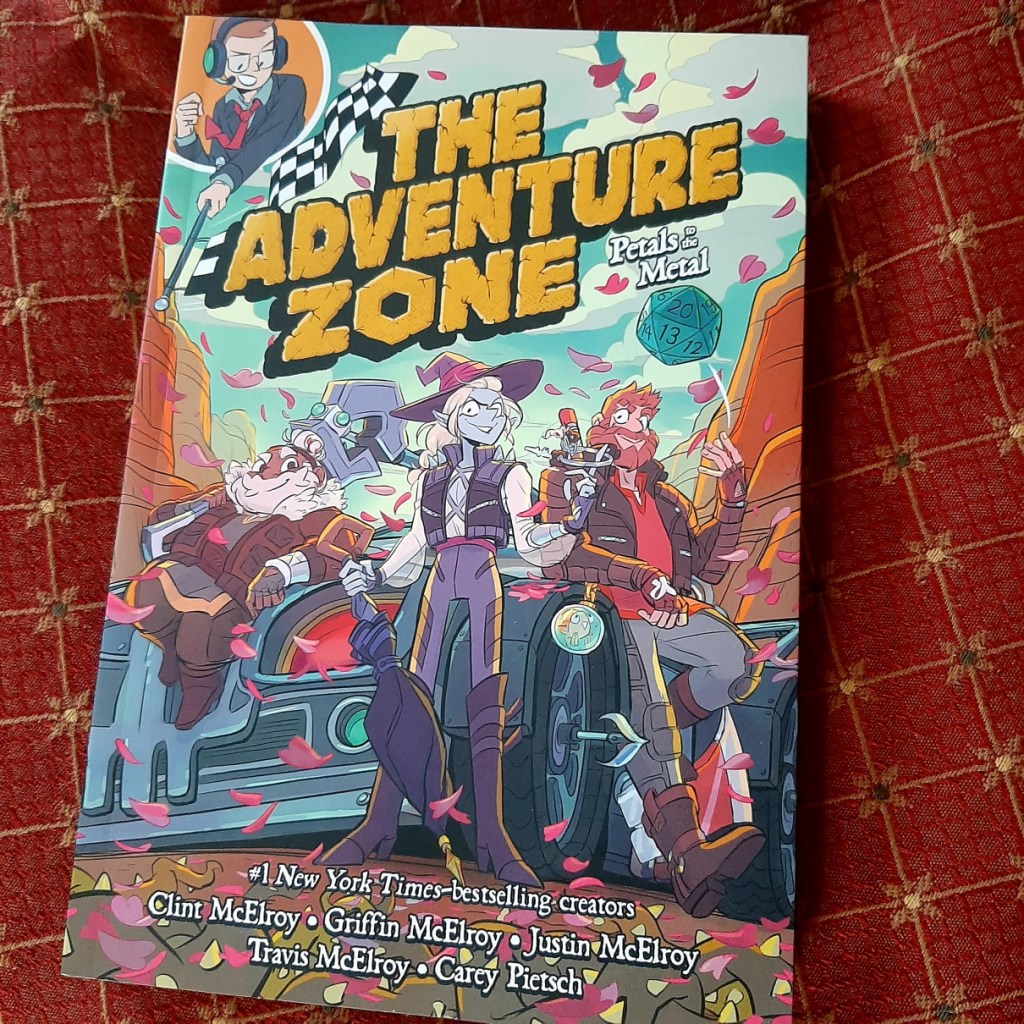
Book Review | The Adventure Zone- Petals to the Metal by Pietsch & McElroy

Ah, another Adventure Zone graphic novel. These hadn’t let me down in previous installments so I had my hopes set pretty high for this one, and I’m happy to say that I wasn’t disappointed.

There’s a lot that happens here, but a quick sum-up would be that Merle, Taako, and Magnus (have they gotten the moniker tres horny boys yet?) are sent to retrieve The Gaia Sash, an artifact that has the power to control nature. In attempting to do so, however, they run into The Raven, a thief who now controls the Gaia Sash. In order to take the sash back they team up with Hurley, a member of the Goldcliff militia and The Raven’s former battlewagon racing partner, racing (literally) to take back the Gaia Sash and rescue Hurley’s partner, and lost love, from its power.

Okay, so there’s a lot to like about this story, but first and foremost I’ll say that it’s well-paced. There’s a lot that happens in this book, from a foreboding and mysterious presence looming large over the moon base, to a bank-heist, to an undercover mission, to the race itself, and none of it feels as if it takes up too much space in the narrative. If anything, there’s a small portion that I would have liked to see more of (the undercover section was much-shrunk in this version compared to the podcast), as the brevity created one of those short little ‘did-I-miss-something’ moments that I found in the first volume. However, given the space allowed in which to tell the story I understand the decision. What’s important is that the story never drags, with the normal amount of humor throughout, and the important parts of the narrative are given the emphasis they deserve.

Notably this is the case with Sloane (The Raven) and Hurley. One of the things The Adventure Zone does well is its secondary characters and that’s no exception here. It’s not always easy, inserting a new character in and balancing them with the established cast, but Hurley’s interactions with the normal group are fun. She’s got just enough chaos to fit in with the crew while still maintaining herself as the sane one. We see less of Sloane, but the comic does a pretty good job of showing some pre-gaia-sash moments and I found myself genuinely really loving those two characters and rooting, throughout the story, for them to find their way back to each other.

Okay, so spoilers here for those familiar with the podcast but not the comic, but I fail to see how I can accurately review this book without mentioning this. If you want to avoid that, skip this paragraph. There was a problem that the McElroy’s ran into, when originally creating the podcast. A problematic (I hate the word but it is what it is) decision in the way the story was resolved, that was not done to be hurtful but ultimately still was. It was a relief to find that they, in adapting the story to graphic novel, managed to simultaneously stay true to the original story that they created while fixing the problem. My favorite part about this comic, actually. Yay for opposing toxic tropes!

Ultimately, I think this is my favorite Adventure Zone Graphic Novel so far. The story and humor are there, with a splash of drama and mystery to go along. Plus, WLW romance!

What I’m reading in January 2021

So, it’s probably a little late for a TBR post. Honestly, I thought it was late when I’d initially decided to post it, back on the 6th. It was just sitting there in my drafts, ready to publish and… well, you may be able to guess why the post slipped my mind. Be that as it may, here’s the books I picked out as maybes for this month.

Lord of the Rings Part one – The Fellowship of the Ring – J. R. R. Tolkien
So, I’ve read the Hobbit. I’ve watched the Peter Jackson films and the Rankin/Bass films. I’ve never, however, actually read the Lord of the Rings trilogy and it’s about time I fix that. 

Crank- Ellen Hopkins
I have a small collection of this author’s work, thanks to a local thrift store, but this will be the first I’ll get to if it gets pulled out of the pile this month. It deals with some pretty heavy subject matter, but I love stories told through poetry, which is this author’s thing

The Fool’s Girl by Celia Rees
So I had intended on picking this one up last month, but it got pushed off a bit. So far I’m really liking the writing style. It veers between first and third person narration, which I don’t see very often.

Looks Who’s Back-  Timur Vermes
A few years ago I saw the film adaption of this book and found it… well, a story about Hitler, without explanation, winding up in present-day Germany? I like weird stuff like that sometimes, especially when it’s trying to make a point rather than being absurd simply to be absurd.

Honestly starting to rethink this one at this point…

The Case for God – Karen Armstrong
Afraid I didn’t make it very far in the book in December. Got a bit bogged down by the early Christian theologians and the creation of the trinity. Hitting slow spots is pretty normal for me in regards to nonfiction works though. I’ve found I just have to read a bit of them at a time. We’ll see how it goes in January.

Critical Role Vox Machina origins Vol 1
So I’ve already read this one once, but I received Vol 2 for Christmas which means it’s time for a reread!

Critical Role Vox Machina origins Vol 2
I love Critical Role. Seriously, it was my main obsession for over half a year at one point- the second campaign at least. If you’re familiar with it you’ll know how much of a time-sink the show is, so campaign one… well, I’m slowly getting there. Very slowly, so I’m looking forward to getting a more manageable chunk of Vox Machina this month.